Operations
Part of B2B email marketing: a practical guide for teams
Email compliance gaps are what a B2B checklist should catch first
B2B email marketing checklist for 2027 covers route approval, address evidence, identity, authentication, message truth, unsubscribe, measurement, and incidents.
What to take away
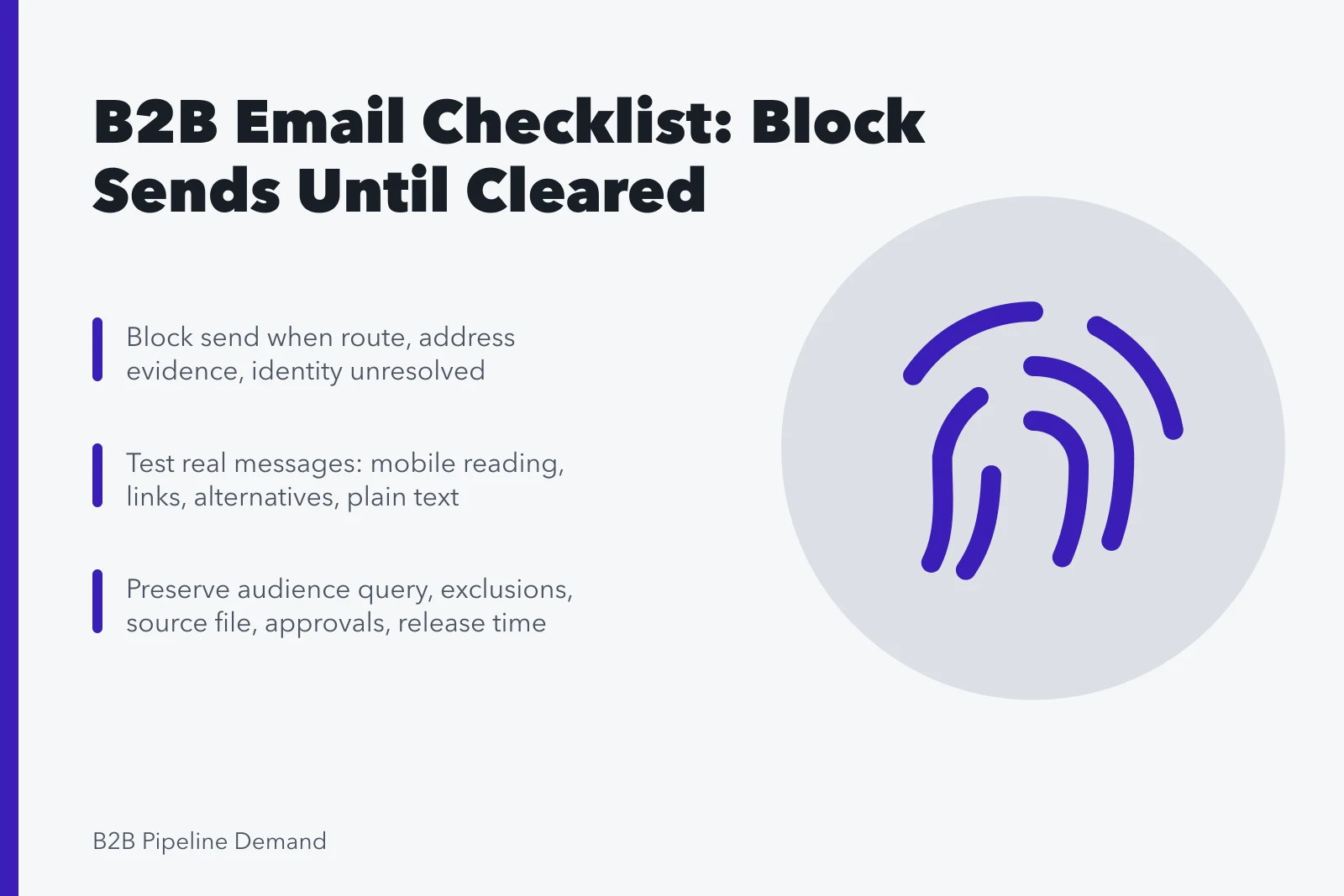
- Block release when the route, address evidence, identity, authentication, suppression, material claim, or incident owner is unresolved.
- Test infrastructure with real messages and test content for mobile reading, logical order, descriptive links, alternatives, replies, and plain text.
- Preserve the audience query, exclusions, source file, approvals, test evidence, release time, and next review date.
A B2B email marketing checklist should block a send when permission, identity, security, suppression, or message truth is unresolved. Mark each item complete, missing, assumed, blocked, or not applicable. Attach evidence and an owner instead of treating the review as a memory exercise.
Purpose, audience, and law
Route approval record
- Message job, recipient, location, purpose documented
- Address source, notice, basis, timestamp retrievable
- Sender identity, postal, privacy duties reviewed
- Qualified reviewer approved high-risk routes
- The message job, recipient, location, purpose, relationship, and commercial or transactional class are documented.
- The address source, notice, consent or other relied-on basis, timestamp, status, and evidence are retrievable.
- Applicable sender identity, postal address, privacy, unsubscribe, timing, and recordkeeping duties were reviewed.
- A qualified reviewer approved cross-border, sensitive-data, novel, or high-risk routes.
Infrastructure and access
CISA's email-security directive groups STARTTLS, SPF, DMARC, reporting, and staged enforcement for federal systems. A private marketing team should use applicable standards and current provider requirements, while preserving its own inventory, test records, owners, and change controls. Unowned routes are a standard B2B email marketing mistake.
- The From identity, reply path, return path, SPF, DKIM, DMARC, DNS, TLS, and message format pass current tests.
- Only authorized services and people can send, and obsolete credentials or domain permissions are removed.
- Volume changes are controlled, traffic classes are observable, and mailbox-provider signals have owners.
- Vendor data flows, subprocessors, retention, incident response, export, deletion, and exit paths are documented.
Message and lifecycle
W3C's writing guidance recommends meaningful link text, useful alternatives, descriptive headings, clear instructions, and concise language. Apply those principles to both the message and its destination, then test with representative clients and assistive technology rather than relying on a template preview.
- The subject and sender are accurate, the reason for sending appears early, and the primary action is clear.
- Entry, timing, frequency, exit, re-entry, exclusions, sales handoff, and reply ownership are approved.
- Personalization uses reliable authorized fields with safe fallbacks and no exposed confidential context.
- Links, rendering, plain text, mobile use, reading order, contrast, alt text, and descriptive labels are tested.
Exit and measurement
These definitions make a B2B email marketing benchmark comparable.
- The visible unsubscribe and any required one-click method work without login or unnecessary friction.
- Suppression is synchronized across marketing, sales, event, customer, agency, and import routes.
- Delivery, bounce, complaint, opt-out, click, reply, conversion, qualified outcome, and cost definitions are recorded.
- Open metrics are labeled as directional where privacy prefetching or bots can distort them.
Release and incident readiness
- Seed tests cover representative records, conditional branches, long values, missing data, and every link.
- The approver, source file, audience query, exclusions, version, test evidence, and release time are preserved.
- Pause authority, escalation contacts, correction steps, affected-record analysis, and notification criteria are ready.
- The next review date and stop conditions are set before the message or automation goes live.
Email release gates
| Gate | Required record | Block when |
|---|---|---|
| Route | Recipient, place, purpose, basis | Facts or approval are missing |
| Identity | Sender, DNS, authentication, reply | A legitimate route fails |
| Recipient | Expectation, value, access, exit | Choice is unclear or broken |
| Control | Owner, tests, metrics, incident plan | No one can pause or correct |
Record the gate result
The W3C Privacy Principles statement gives web-system designers shared privacy concepts and warns against shifting privacy work to individuals. Apply it to the data flows behind the checklist, then review the governing law and configuration.
The CISA software acquisition fact sheet covers development practice, supply-chain exposure, deployment, and vulnerability management. Add those government-acquisition questions to the checklist review without treating them as local approval. The B2B content marketing checklist gates published pages the same way.
Common questions
Who should approve a B2B email checklist?
The accountable sender coordinates the legal, privacy, security, deliverability, accessibility, brand, data, sales, and lifecycle owners the route's risk requires.
Does a checklist guarantee deliverability?
No. It confirms that defined controls and records exist. Provider decisions, recipient response, reputation, content, volume, and changing rules still affect delivery.
When should the checklist be reopened?
Reopen it after a material change to law, provider rules, domain, vendor, data source, audience, automation, volume, or incident status.