Reviews
Part of B2B email marketing: a practical guide for teams
B2B email marketing questions: what people ask and what is true
Common B2B email marketing questions in 2027 cover consent, public and purchased addresses, unsubscribe, authentication, cadence, and decision-based measurement.
What to take away
- B2B is not a universal legal exemption; recipient type, country, purpose, relationship, and data use change the answer.
- A public, scraped, or purchased address does not by itself prove consent, expectation, accuracy, or recipient value.
- Choose one job-specific outcome and use delivery, complaint, unsubscribe, and data-quality measures as guardrails.
Common B2B email marketing questions mix law, mailbox rules, software behavior, and business judgment. The answers below are operational starting points, not legal advice. Map each message to its recipient, location, purpose, relationship, data source, and sending route before deciding what is permitted or useful.
Does business email need consent?
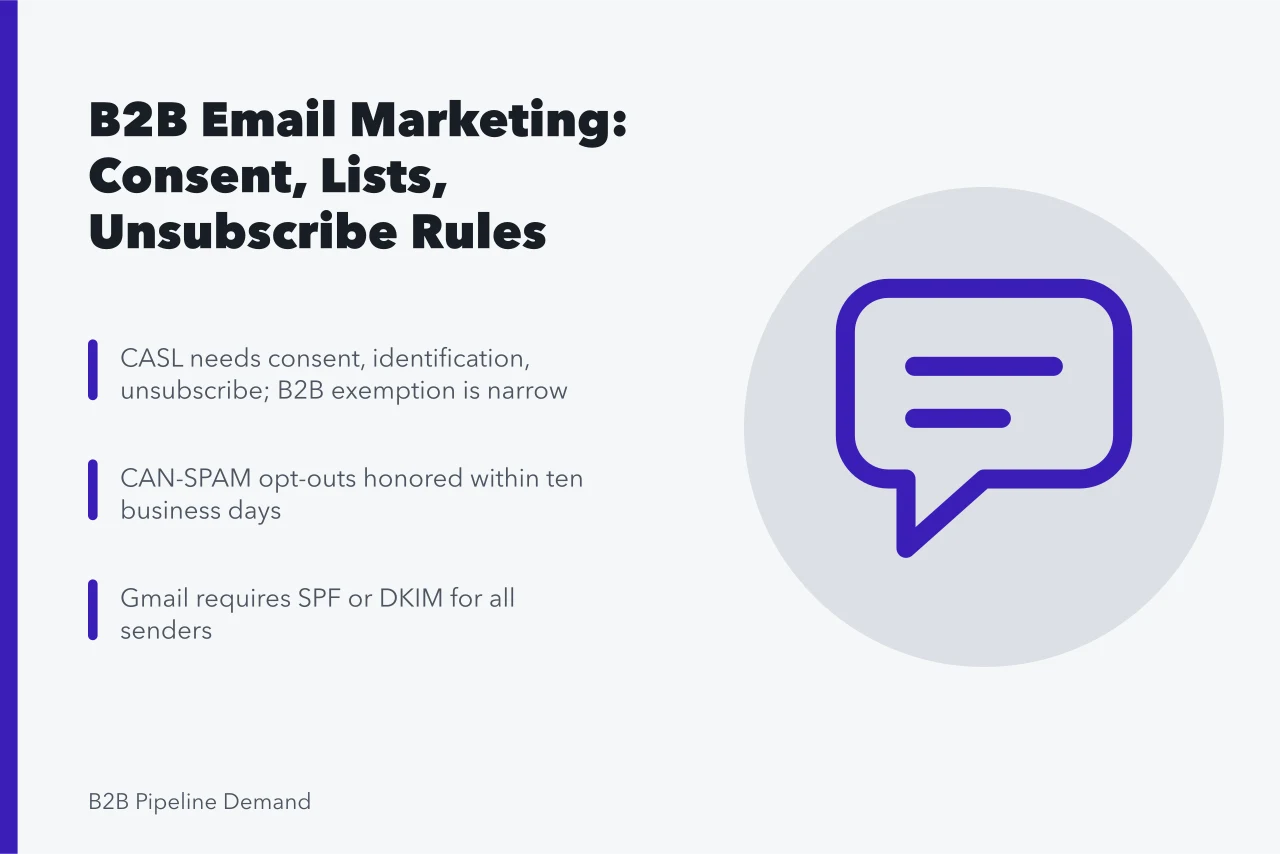
The CRTC says CASL generally requires consent, identification information, and an unsubscribe mechanism, while its business-to-business exemption applies only when specified organizational relationship and message conditions are met. Preserve the evidence for the exact route instead of relying on a B2B label.
U. S. CAN-SPAM covers B2B commercial email but is primarily an opt-out regime, while Canada's CASL requires consent, identification, and unsubscribe, with only limited exceptions.
Can a team use bought or scraped lists?
The UK ICO explains that electronic-mail treatment differs for corporate and individual subscribers, while personal-data duties can still apply to named business contacts. It also states that businesses and contacts can object to direct marketing.
A vendor's assurance does not establish permission, accuracy, expectation, or inbox value. Bought lists also generate complaints, invalid addresses, privacy risk, and misleading identity. Earning the address instead is the work of B2B lead generation, where every contact carries a record of how it was collected.
What must an unsubscribe do?
Make leaving clear and easy, then honor it within the applicable time. CAN-SPAM requires honoring opt-outs within ten business days. Australia specifies five working days. Gmail requires one-click unsubscribe for covered high-volume marketing and subscribed messages, plus a visible unsubscribe link in the body.
Are SPF, DKIM, and DMARC optional?
Google requires SPF or DKIM for all senders to Gmail accounts and adds SPF, DKIM, DMARC, and alignment requirements for senders over its bulk threshold. Even below that threshold, authentication establishes domain control and supports diagnosis. Inventory every legitimate sending service before changing records.
How often should B2B email be sent?
There is no universal cadence. Start from the promised frequency, decision cycle, value of each message, and total pressure across marketing, sales, product, and customer teams. Offer preferences, monitor complaints and opt-outs by segment, and pause when the program has nothing useful to say.
Which metric matters most?
Which events count as evidence is a B2B marketing analytics question as much as an email one. Pick the metric tied to the message's job: qualified reply, evaluation step, adoption event, renewal, or attributable purchase.
Delivery, bounce, complaint, unsubscribe, and click metrics are guardrails, while open events are imperfect because privacy prefetching can record activity without a human reading.
Question-to-evidence map
| Question | Evidence needed | Unsafe shortcut |
|---|---|---|
| May we send? | Route-specific legal and provider review | Calling every contact B2B |
| Where did it come from? | Source, notice, date, purpose, status | Vendor assurance alone |
| How often? | Promise, value, total pressure, feedback | Copying an industry cadence |
| Did it work? | Job outcome plus guardrails | Open rate alone |
Resolve the question with a decision record
The GAO evaluation design guide connects evaluation questions with evidence needs and design choices. Apply that discipline here, and to the slower work of improving B2B email marketing; federal evaluation guidance does not make a local marketing result causal or transferable.
The W3C Privacy Principles statement gives web-system designers shared privacy concepts and warns against shifting privacy work to individuals. Review the governing law and your own configuration against it.
Common questions
Is a work email address automatically fair to use?
No. A work address does not settle consent, lawful basis, expectation, purpose, accuracy, provider policy, or usefulness. Review the complete route.
Should every marketing email include an unsubscribe?
Provide what the applicable law and mailbox rules require, and make leaving easy on every route even where a narrow exception exists.
Can sales outreach and marketing share one suppression list?
They need a coordinated suppression design, but qualified owners should define the stored fields, scope, legal treatment, and exceptions for each route.