Operations
Part of How B2B content marketing works for a business team
What the B2B content marketing best practices look like in practice
B2B content marketing best practices for 2027 serve a defined reader, add inspectable value, show authorship, control claims, plan distribution, and stay accurate.
What to take away
- Best practice in practice means four recordsa reader brief, a method note, a claim register, and a dated gate list.
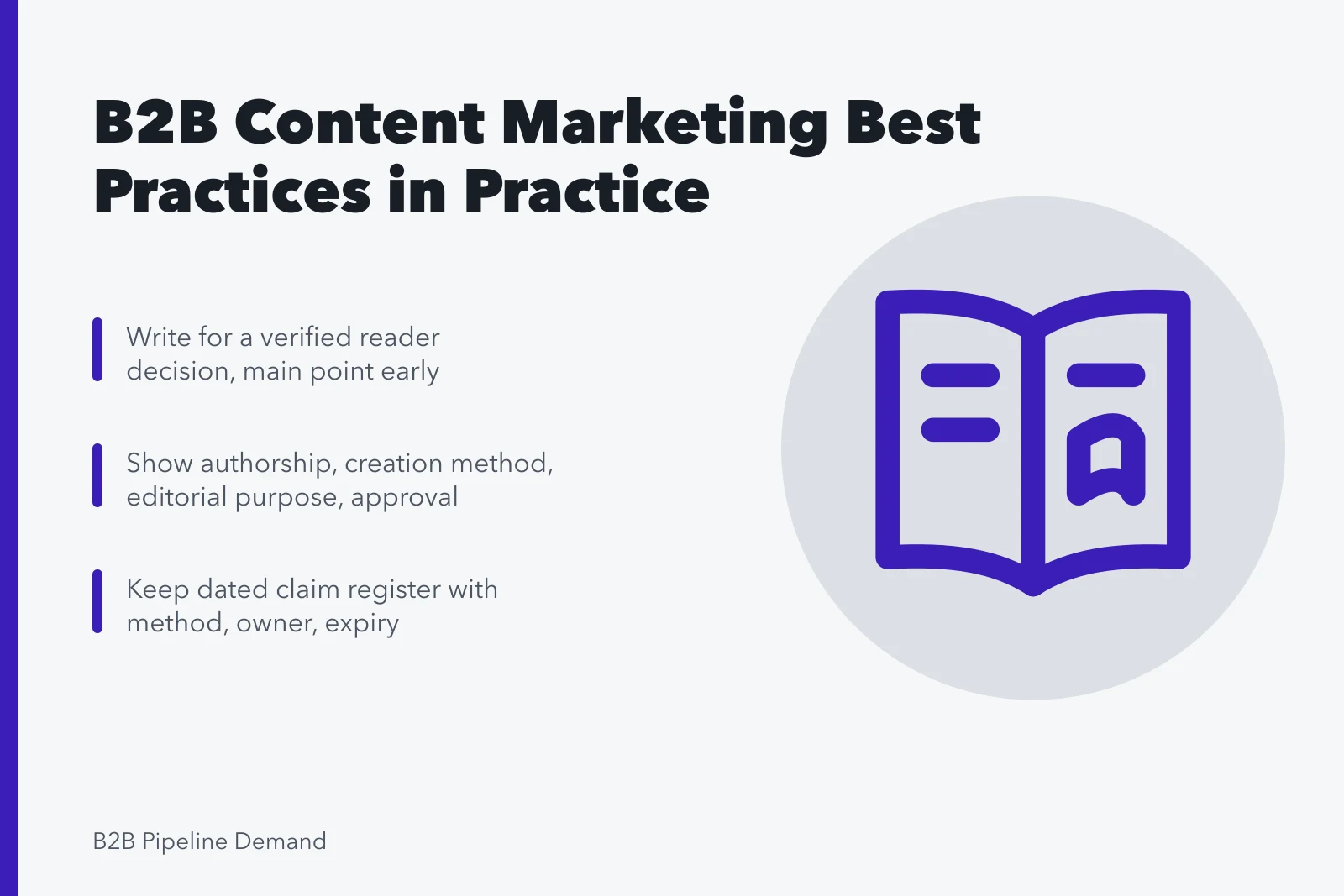
- Write for a verified reader decision and state the main point early. Name the creator, the reviewer, the automation used, and who approved it.
- Set distribution, review, correction, and retirement dates before production becomes expensive.
B2B content marketing best practices protect usefulness and trust while giving teams a repeatable operating system. They are not ranking shortcuts or universal production rules. Adapt them to the audience, decision, product, evidence, regulation, channel access, and company capacity, then record why an exception is necessary.
Serve a defined reader decision
The National Archives' plain-language principles recommend writing for the reader and stating major points first while using concise language, headings, and proofreading. The page lists 10 principles. Adapt the style to the reader's expertise rather than removing necessary precision.
Reader brief essentials
- Name the business audience
- Name the buying role
- Describe the situation
- State the promised help
- Give the next useful action
Name the business audience, buying role, situation, promised help, and next useful action. Validate the brief through interviews and operating data. The work should remain useful to a reader who arrives directly, not only to search traffic.
Create original value a reader can check
Contribute research, accountable expertise, product evidence, tools, templates, or a synthesis that resolves a real tradeoff. Preserve sources, method, assumptions, and limits. Do not confuse novel wording with novel information. Let readers see how the recommendation follows from the evidence.
Concrete B2B content marketing examples show how a method note, a claim register, and a source table look on a live page.
Checkable value means a reader can open the source and see the limit. Copy this method note:
- What we did
- the method in one line.
- Sample
- who was measured and how they were chosen.
- Dates
- fielding and analysis dates.
- Limits
- what the sample cannot support.
- Review
- who checked the evidence.
Show Who, How, and Why
Google's generative-content guidance recommends accuracy, quality, relevance, metadata, and context about how content was created. Treat this as publishing guidance, not a ranking promise, and keep human review for every consequential claim.
Use accurate authorship, relevant biographies, qualified review, a creation-method note, and a clear editorial purpose. Google explicitly recommends evaluating Who created content, How it was produced, and Why it exists. Material artificial intelligence assistance needs source validation, human accountability, and disclosure when readers would expect it.
Control every consequential claim
Maintain a dated claim register for customer outcomes, comparisons, product capabilities, statistics, quotations, and expert conclusions. Record method, population, permission, limit, owner, and expiry. Correct errors and remove claims whose support has expired.
Worked example: a usage-billing buyer guide
- Reader brieffinance director, economic buyer, renewal inside two quarters, promised help is a cutover plan, next action is the worksheet.
- Method noteinterviews with finance leads who completed a switch, limits stated.
- Claim register rowproduct capability, documentation source, current release limit, product marketing owner, next release expiry.
- Distribution gatesales sends it with renewal notices, progress counts replies from named accounts, work stops after one quarter without a send.
Plan distribution before production
Choose search, email, social, events, communities, partners, paid promotion, sales, customer success, and product surfaces based on audience access and content job. Adapt the asset for each environment without changing its meaning. Set the gates before drafting: who sends it, which account list receives it, what counts as progress, and the date the work stops without that progress.
Each gate above is a line item in the B2B content marketing checklist.
Measure, refresh, and retire
Use quality, intended reach, useful consumption, account progress, sales use, customer outcomes, and economics as appropriate. Keep platform scopes and limits visible. Assign review frequency from risk and volatility. Refresh sources and usefulness, consolidate duplication, redirect or archive obsolete work, and preserve correction history.
No public benchmark fits every pipeline. The target depends on the account list, the sales cycle, and how often sales sends the asset. A workable default: review pricing, regulatory, and outcome claims every 3 months, and stable explainers every 12 months.
The records and their failure signals
| Record | What it holds | Failure signal |
|---|---|---|
| Reader brief | Role, situation, decision, next action | The audience is a keyword, not a role |
| Method note | Method, sample, dates, limits, reviewer | Sources listed, limits missing |
| Source table | Each source, its date, what it supports | A claim points at no source |
| Claim register | Claim, source, limit, owner, expiry | A live claim with no expiry date |
| Refresh log | Review date, corrections | Review date passed with no edit |
Assign the practice
The NIST Privacy Framework starting guide outlines a voluntary process for identifying and managing privacy risk. Content teams borrow one habit: name who answers a reader data request. It is not legal clearance.
The CISA business-system logging guidance explains how event records support security review. Apply the same discipline to claims: source, date, correction. Those records also feed the B2B content marketing benchmarks a team reports on: claim expiry rate, review dates met, and sales use.
Common questions
How many B2B content best practices should a team use?
Use the smallest set that controls the actual reader, evidence, claim, distribution, measurement, and maintenance risks, with an owner for each gate.
Does plain language mean oversimplifying technical content?
No. It means organizing information for the intended reader, leading with the point, defining necessary terms, and removing complexity without changing the evidence.
When should an article be retired?
Retire or archive it when the decision no longer matters, evidence cannot be repaired, the product or law has changed, a stronger destination exists, or maintenance cost exceeds value.