Costs
Part of B2B email marketing: a practical guide for teams
How to improve B2B email marketing for business teams
How to improve B2B email marketing in 2027: repair address evidence, sender identity, authentication, lifecycle logic, testing, suppression, and measurement.
What to take away
- Diagnose by address source, sender, domain, segment, message, sequence, and period so a harmful route cannot hide in an average.
- Repair acquisition and expectation before copy, templates, cadence, automation, or software.
- Change one material factor at a time and confirm that recipient, deliverability, sales-quality, and business outcomes improve together.
Learning how to improve B2B email marketing starts with a route-level diagnosis. Export performance by address source, consent or relied-on basis, sender, domain, segment, message, sequence, and time. Compare technical acceptance, delivery signals, complaints, opt-outs, clicks, replies, useful actions, sales outcomes, and cost.
Repair acquisition and expectation first
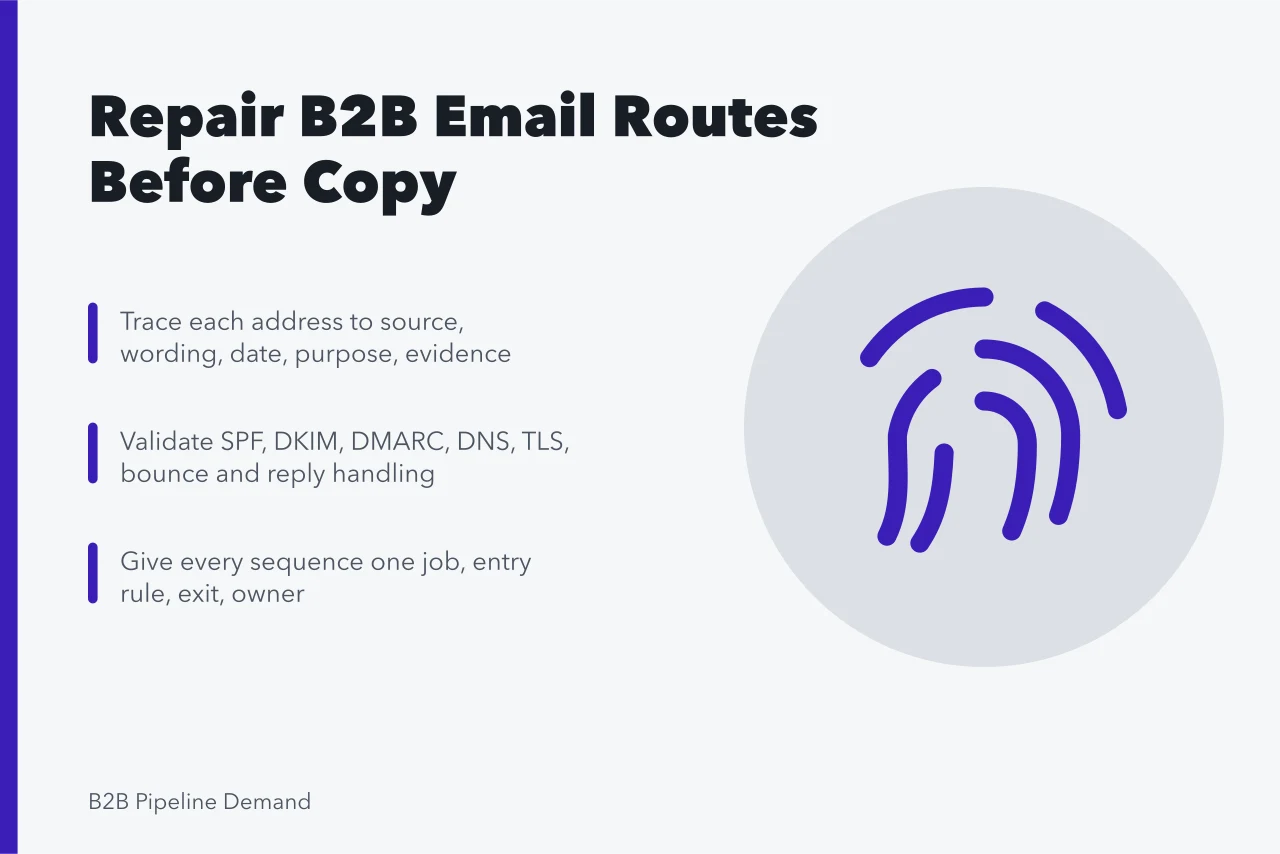
Trace every address to its source, wording, date, purpose, and evidence. Stop imports that cannot establish a lawful and reasonable route. Rewrite forms so sender, content, frequency, data use, and exit are clear. Remove inactive records under a documented retention policy instead of mailing people who never asked.
Fix identity and infrastructure
Gmail's sender guidance requires controls including authentication, valid DNS, TLS, message-format compliance, and low spam rates, with additional SPF, DKIM, DMARC, alignment, and unsubscribe duties for bulk senders. Treat those as provider-specific requirements and verify every sending route rather than assuming a platform configured it correctly.
Inventory senders, align From identities, secure accounts, and validate SPF, DKIM, DMARC, DNS, TLS, bounce processing, reply handling, and unsubscribe. Warm a changed route with expected recipients and controlled volume, then watch each mailbox provider and traffic class separately. Routes opened by B2B marketing automation belong on that inventory too, including ones a platform set up years ago.
Redesign the lifecycle decision
Give every sequence one job, entry rule, exit, re-entry policy, and owner. Replace calendar filler with messages that help the recipient perform the next decision. Suppress people who have converted, complained, opted out, entered a sensitive service state, or no longer fit. Coordinate pressure across marketing and sales.
Improve one message at a time
Make the subject accurate, put the reason for sending early, reduce competing calls to action, and give enough evidence to evaluate the click. Test links, personalization, conditional content, plain text, mobile display, accessibility, and replies. A polished template cannot compensate for an unwanted message or irrelevant offer.
Use metrics that survive privacy changes
Mailchimp notes that Apple Mail Privacy Protection and bot activity can inflate opens and some clicks. Evaluate click quality, replies, destination behavior, conversion, qualified account progress, complaints, and opt-outs alongside delivery. Set an internal baseline for comparable messages rather than treating a dated cross-industry average as a promise. Building that baseline is B2B marketing analytics work applied to one channel.
Run a bounded improvement cycle
NIST's Trustworthy Email publication describes SPF, DKIM, DMARC, TLS, DNS, and content-security mechanisms for improving trust in email. Use the relevant controls as a technical review framework, not as proof that a marketing message is wanted or lawful.
Choose the largest verified failure, state a hypothesis, change one material factor, protect a comparison where practical, set a decision window, and record the outcome. Preserve neutral and negative tests. If results improve, confirm that complaints, unsubscribes, sales quality, and downstream outcomes did not worsen before scaling.
Improvement priority record
| Observed failure | First repair | Scale only when |
|---|---|---|
| Complaints by source | Acquisition and expectation | The source is defensible |
| Authentication failures | Inventory and domain alignment | Real messages pass tests |
| Weak downstream action | Lifecycle decision and evidence | Useful action improves |
| Conflicting reports | Definitions and identity rules | Differences are explained |
Run a controlled handoff
The GOV.UK technology selection guidance recommends adaptable choices, data control, security review, and ownership-cost analysis. Use those public-service questions when assessing email tooling; they are not product endorsements. A tool choice does not settle the common B2B email marketing questions about consent, identity, and cadence.
The CISA software acquisition fact sheet covers development practice, supply-chain exposure, deployment, and vulnerability management. Add those government-acquisition questions to an email tooling review without treating them as local approval.
Common questions
What should be fixed first in B2B email?
Fix the largest verified recipient, legal, security, suppression, or deliverability failure before optimizing presentation or adding volume.
How long should an email improvement test run?
Use a preset window that fits message frequency, sample needs, decision timing, reporting delay, and business outcome. Do not stop merely when a favorable result appears.
Should inactive contacts be mailed again?
Only through a documented route with a defensible basis, clear expectation, useful reason, low pressure, and stop rule. Repeatedly mailing silence is not evidence of interest.