Operations
Part of B2B social media marketing for people who want the details, 2027 edition
How to improve B2B social media marketing for business teams
How to improve B2B social media marketing in 2027 through audience repair, original evidence, genuine participation, controlled distribution, and clear metrics.
What to take away
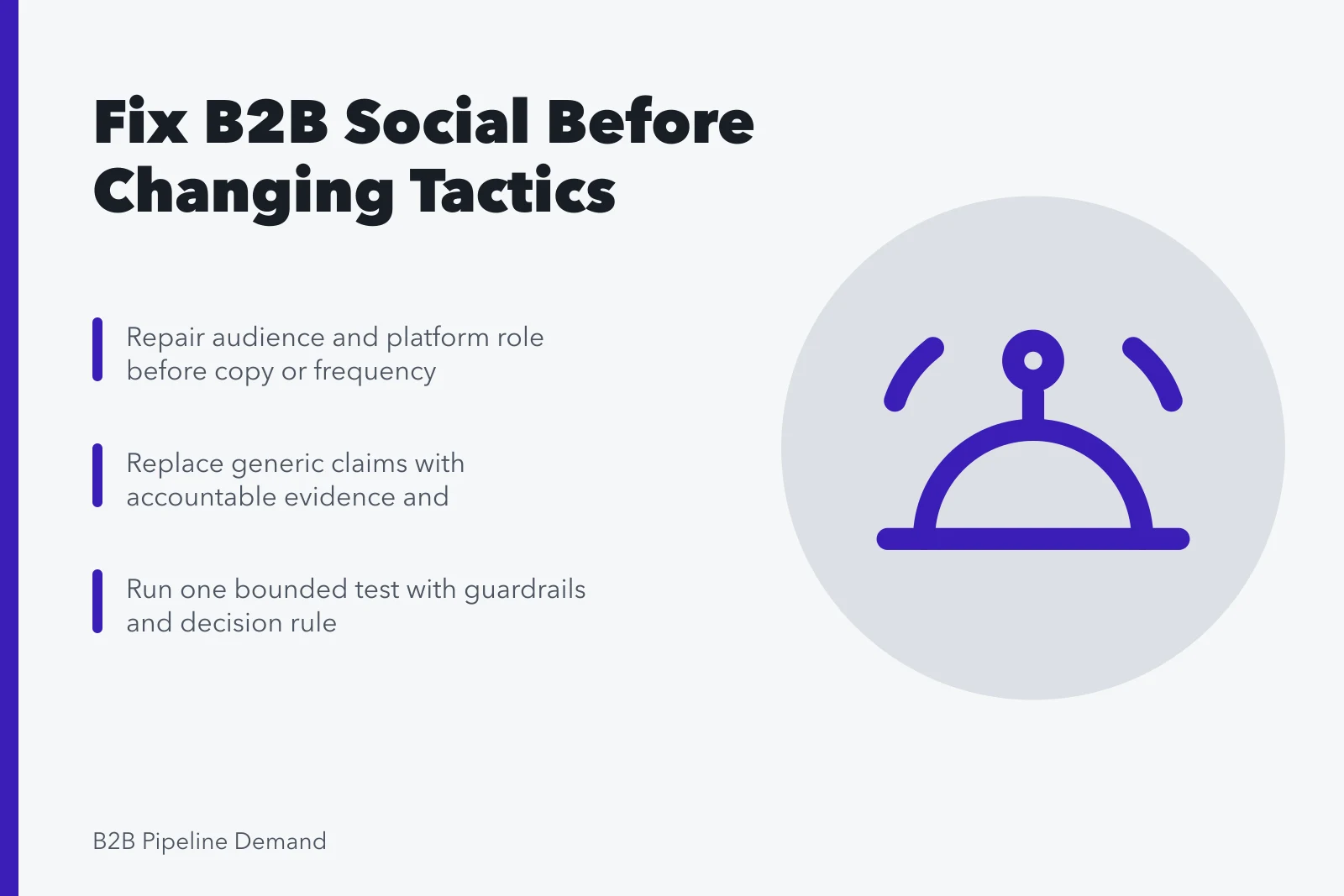
- Repair the audience and platform role before changing copy, frequency, format, paid support, or software.
- Replace generic claims with accountable experience, research, demonstration, customer evidence, or a useful decision tool.
- Run one bounded test with a stated outcome, guardrails, window, exclusions, and decision rule.
Improving B2B social media marketing starts with diagnosing the program by audience, platform, account, content series, format, paid or organic route, and business job. Compare strong, average, weak, and discontinued activity. Include comments, direct messages, destination behavior, sales feedback, costs, corrections, and negative signals.
Repair the audience and platform choice
Digital.gov's plain-language guidance recommends listening to user questions, talking with users, reviewing web behavior, and separating audiences with different needs. Adapt that reader-centered research discipline to a commercial buying group without implying that federal guidance validates a market conclusion.
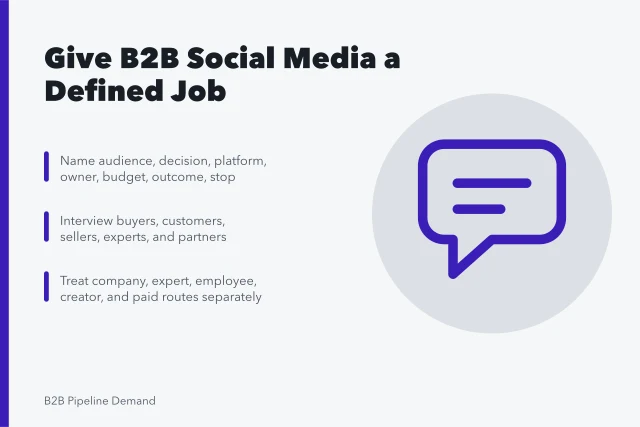
Name the buying role, situation, decision, proof need, and reason that person uses the network. Interview buyers and non-buyers instead of inferring preference from followers alone. Stop platforms with no defensible audience or operating capacity. Give each retained network a distinct role and format plan.
Replace generic posts with evidence
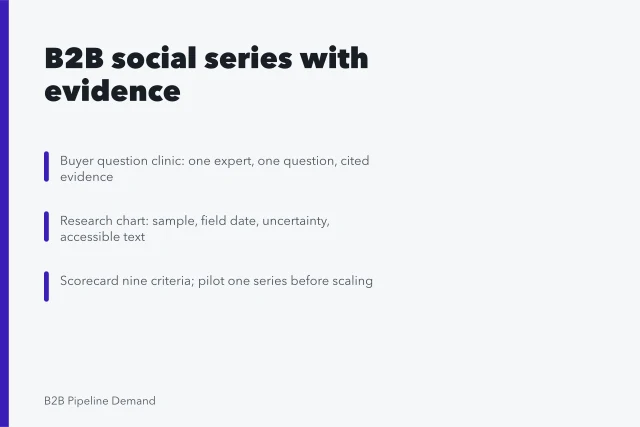
Build recurring series from research, expert practice, product data with permission, customer questions, implementation lessons, experiments, market changes, and informed disagreement. Identify the accountable author and limitations. The production plan behind B2B content marketing reuses the same source material across formats.
Improve participation, not only publishing
Answer substantive comments, route service issues, thank useful corrections, ask focused questions, and join relevant conversations with actual expertise. Give executives and employees optional source material and training rather than identical scripts. Preserve recurring questions as research without exposing private information.
Control distribution and frequency
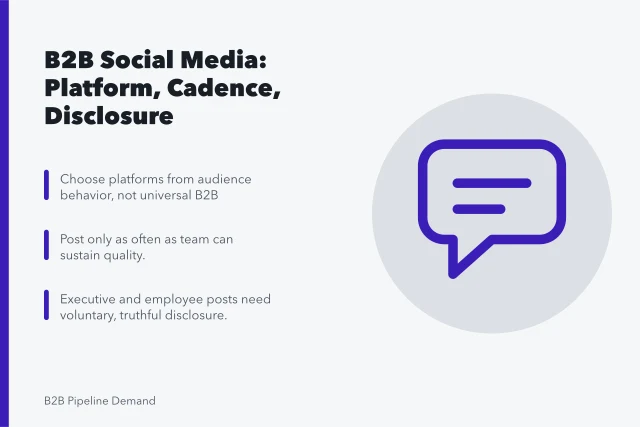
Use paid reach, employee participation, creators, partners, events, email, and sales sharing only when the audience and purpose are explicit. Coordinate total activity across accounts. A paid boost cannot repair an unclear idea, while repeated internal sharing can make weak engagement look stronger than external interest.
Fix measurement definitions
LinkedIn says Page impressions and members reached are estimates, defines engagement rate as interactions divided by impressions, and notes that most metrics may take up to 48 hours to appear. Preserve those platform-specific metric definitions and delays beside every comparison, and do not force unlike reports to match.
Preserve each network's definitions, dates, attribution, and eligibility. Separate paid and organic results, employee traffic, staff activity, repeat views, and modeled influence. Reconcile platform data with destinations, CRM, interviews, experiments, and finance evidence. That reconciliation is the daily work of B2B marketing analytics, which fixes the definitions a team reports against.
Run one decision test
Choose a material variable: evidence type, spokesperson, format, audience, or hook. Test destination or paid distribution. Before launch, write hypothesis, primary outcome, guardrails, window, stop rule; preserve neutral and negative results.
Scale only when audience quality and downstream value improve without unacceptable complaints, moderation load, or cost. Repeat the test in another comparable period before treating the pattern as durable.
Improvement test record
| Observed problem | First repair | Evidence of progress |
|---|---|---|
| Weak audience response | Audience and platform fit | More qualified questions |
| Generic content | Original source and accountable author | Useful saves, replies, or use |
| Uncontrolled reach | Distribution role and exclusions | Qualified exposure within limits |
| Conflicting reports | Definitions, scope, and window | Differences are explained |
Run a controlled handoff
The GOV.UK technology selection guidance recommends adaptable choices, data control, security review, and ownership-cost analysis. Use those public-service questions when assessing a social program; they are not product endorsements.
The CISA software acquisition fact sheet covers development practice, supply-chain exposure, deployment, and vulnerability management. Add those government-acquisition questions to a social program review without treating them as local approval. The common B2B social media marketing questions collect what teams ask before dropping a platform or a format.
Common questions
What should a B2B social team improve first?
Fix the largest verified audience, claim, access, disclosure, service, or measurement failure before increasing production or paid reach.
How long should a social media test run?
Choose a preset window that fits audience size, publishing frequency, reporting delay, buying cycle, and the decision the test must support.
Should a team delete every low-performing format?
No. Check whether the format served a different audience or decision, whether distribution was sufficient, and whether the metric measured its actual job.