Operations
Part of B2B social media marketing for people who want the details, 2027 edition
Getting B2B social media marketing examples right the first time
B2B social media marketing examples that work name real companies, show the mechanism behind each post, and state what the reader can copy today.
What to take away
- Copy the mechanism behind a post, not the post: who contributed, what evidence backed it, and who answered the replies.
- Every example below is a named program you can look up, not a hypothetical format.
- Budget one owner for responses before you publish anything, because unanswered comments are the most common failure.
- Accessibility belongs in the brief: alt text, captions and transcripts get built with the asset, not bolted on after.
- Keep substantive replies and corrections in a record you control, not only inside the platform.
B2B social media marketing fails when a team copies a post's look and skips its machinery. The programs below are named, public and checkable. Copy the mechanism, then rebuild the audience and the evidence for your own category.
Named examples worth studying
Maersk on LinkedIn and Instagram. One of the world's largest container lines posts from vessels and terminals: crew, ports, cargo, weather delays. The subject matter is the product, and the people in the photos do the work. Copy the contributor model, not the photography budget.
GE Aerospace's Building the Future series. Engineers explain one component or test in short video. Each post carries a named engineer and a specific artifact, so it reads as evidence rather than brand voice. GE Aerospace builds and services commercial and defense engines.
Cisco's #WeAreCisco. Employees publish under their own names with a shared hashtag and a supplied asset library. The careers team also publishes disclosure rules for participants. The mechanism is the library plus the rules, not the hashtag.
Microsoft's Azure and Copilot channels. Product teams push release notes, deprecation notices and known-issue updates through LinkedIn and X. Azure also runs a dated update feed on its own blog. The value is the correction loop: when a claim is wrong, the same channel carries the fix.
Salesforce's Trailblazer community. Customer and partner posts are surfaced through official channels under the community's own moderation rules. Trailblazer includes user groups and MVP recognition. The mechanism is a moderation policy the audience can read.
IBM's Think blog distribution. A research or policy piece is cut into a chart, a quote and a question, each pointing back to the full argument. The chart carries its method. IBM Think covers AI, quantum computing and semiconductors.
Siemens' Pictures of the Future. The industrial group's research magazine covers long-horizon work in automation, energy and rail. Siemens careers content reuses the same faces across years, which builds recognition a single campaign cannot.
Zoom around Zoomtopia. Agenda posts, session recaps and answers pulled from the live chat run before and after the annual user conference. The aftercare is the point: missed questions get answered in public.
Hootsuite and Buffer. Both publish their posting cadence, testing notes and mistakes. Buffer also publishes its salary formula and its State of Remote Work survey. They are useful because the vendor shows the working, including the parts that did not perform.
Stripe's developer changelog. Stripe lists API changes and deprecations in a public changelog aimed at the developers who build on it. Each entry names the version, the date and the impact.
AWS What's New. Amazon Web Services publishes a dated feed of service launches and feature updates, listed by region. Teams that watch it plan migrations instead of discovering a change after it ships.
Ahrefs data studies. The search tool company publishes studies and tool walkthroughs on its blog and YouTube channel. Each study states its method and sample, which is what makes the numbers quotable in sales conversations.
LinkedIn's B2B Institute. The platform's research arm publishes free reports on B2B buying behavior, including work on the 95-5 rule, its finding that about 95% of potential buyers are out of market at any moment.
Score the idea before you brief it
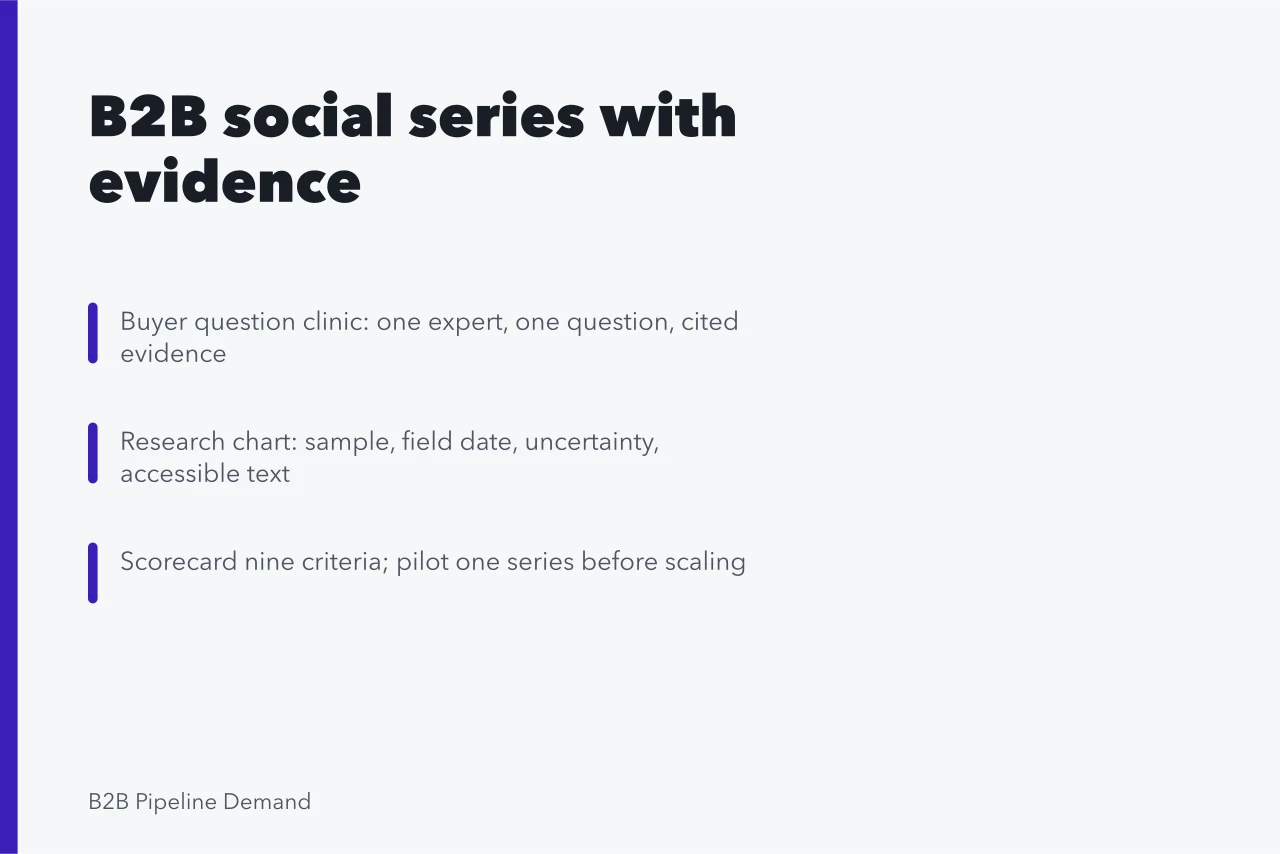
Score audience importance, decision value, evidence access and contributor credibility. Add platform fit, claim risk and moderation capacity. Reject a format you cannot staff with a named contributor and a named responder. Pilot one series for a quarter before adding a second.
| Example type | Best evidence | Required aftercare |
|---|---|---|
| Buyer clinic | Recurring evaluation question | Answer, correction, escalation |
| Field note | Named practitioner experience | Limits and version review |
| Research chart (IBM Think) | Method and accessible data | Source and correction record |
| Customer decision | Permission and outcome method | Claim and relationship review |
| Release note (Stripe, AWS) | Version, date, affected customers | Correction and deprecation path |
| Employee advocacy (Cisco) | Contributor name and disclosure | Asset library and moderation rules |
Build accessibility into the brief
W3C's authoring guidance says social publishing tools should help authors produce accessible content, including alternatives for images, captions, transcripts and video descriptions. Put accessible authoring and multimedia support in the brief. Test the real workflow rather than the feature label.
The W3C explanation of information and relationships adds a check most teams skip: visual structure should also reach assistive technology. Run that check on one published post before you scale the series.
Keep a record outside the platform
NARA's federal guidance says a complete social media record can require content, context, structure and metadata such as author and date. It also discusses capture outside the platform.
Private teams can borrow that content-and-context record model where business, legal or research needs justify retention, subject to their own privacy rules. Name the retention authority in your jurisdiction before you archive anything.
Classify the replies you get: substantive questions, corrections, objections, service issues and private follow-ups. Compare them with the decision the post was meant to drive. The same replies feed improving B2B social media marketing next quarter.
The NIST Privacy Framework starting guide describes a voluntary process for identifying and managing privacy risk. Use it to assign data and response owners. It is not legal clearance, and consent rules vary by jurisdiction, so route questions to qualified counsel.
Common B2B social media marketing questions cover the objections these formats attract.
Common questions
Which example should we copy first?
Pick the one whose evidence you already have: a named practitioner, a method you can publish, or a recurring customer question. The smallest repeatable format beats a polished one you cannot sustain.
Can we run the same post on every platform?
Reuse the idea, rebuild the context. Length, format, accessibility, disclosure, destination and the person answering replies all change with the platform's role.
What makes an example credible?
A recognizable contributor, an inspectable source, stated limits and disclosed relationships. A real reply, and a visible correction when you get something wrong. Polish ranks last.