Careers
Part of B2B social media marketing for people who want the details, 2027 edition
Platform choice, cadence and disclosure: common B2B social media questions
Common B2B social media marketing questions in 2027 cover platform choice, cadence, executive accounts, advocacy, creator disclosure, and useful metrics.
What to take away
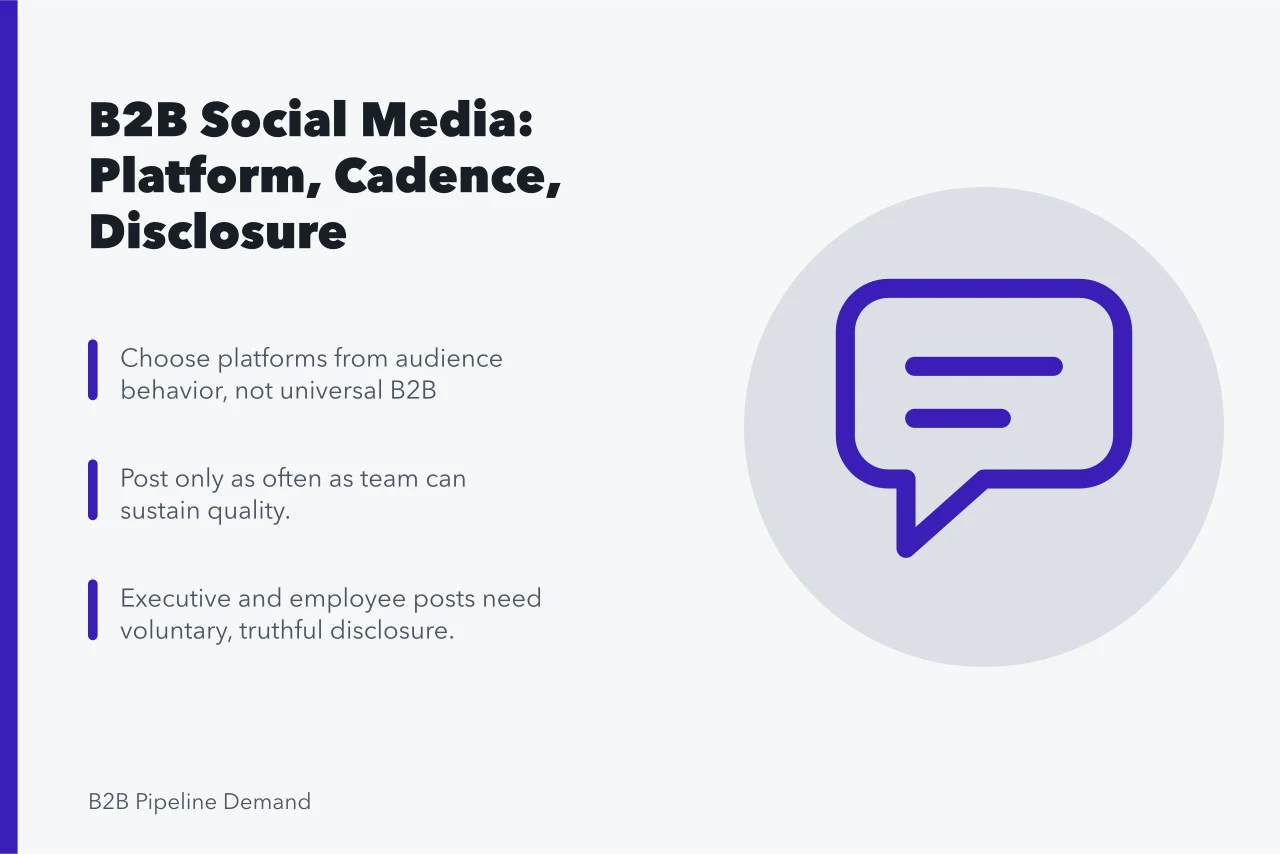
- Choose platforms from verified audience behavior and a specific business job, not from a universal B2B ranking.
- Executive, employee, and creator participation needs truthful claims, clear relationships, voluntary involvement, and an accountable response route.
- Report metric definitions and limitations beside the business question so a reaction count is not presented as pipeline or revenue.
Common B2B social media marketing questions become easier after the team defines the audience decision and business job. Platform norms, features, policies, metrics, and audience behavior vary. Test assumptions in the actual market instead of copying a universal posting calendar.
Which platform should a B2B company use?
Choose where the intended roles already learn, ask, watch, and compare, then assess format fit, community norms, paid reach, analytics, moderation, accessibility, cost, and skill. LinkedIn may matter for many professional audiences, while YouTube, Reddit, industry communities, or another network may better support a specific decision. Presence everywhere is not required.
How often should the company post?
Publish only as often as the team can offer original value, review claims, respond to conversation, measure use, and sustain quality. Start with a small number of recurring series. Increase cadence when evidence shows the audience wants more and operations can support it, not because a generic benchmark prescribes a number.
Should executives use personal accounts?
Personal accounts can carry accountable experience and judgment that a brand feed cannot. Participation should be voluntary and the voice genuine. Interview the leader, verify evidence, preserve approval, and distinguish personal view from official statement. Turning that interview into publishable material is ordinary B2B content marketing. Never publish generated opinions under a person's name without their informed review.
How should employee advocacy work?
Provide training, approved facts, optional source material, disclosure guidance, and clear rules for confidential or regulated information. Do not require undisclosed praise or rank employees by shares. Measure whether participation creates useful professional conversation, learning, event attendance, qualified traffic, or recruitment outcomes.
When does a creator need disclosure?
FTC staff says a material connection can include a personal, family, employment, or financial relationship, including free or discounted products. Its guidance calls for a disclosure that is clear, hard to miss, and placed with the endorsement. Apply the law to the actual post, audience, place, medium, and relationship, and obtain qualified review when needed.
Place the disclosure with the endorsement, where people will notice and understand it. A platform's built-in label may not be enough by itself. Review other relevant countries as well.
Which metrics should leaders receive?
LinkedIn documents separate Page analytics for content, followers, visitors, search appearances, competitors, employer brand, and newsletters. Use those categories only for their defined purposes, then connect the activity to destination and business evidence without implying causation. Making that connection hold up is B2B marketing analytics work.
Report the metrics tied to the job: audience fit, meaningful consumption, qualified discussion, destination behavior, requested contact, opportunity progress, customer action, research learning, reputation evidence, and cost. Add delivery and risk guardrails. Preserve platform definitions because even impressions can be estimated and counted differently.
Question-to-decision map
| Question | Evidence to collect | Unsafe shortcut |
|---|---|---|
| Where should we participate? | Audience behavior and platform role | Copying a competitor |
| Who should speak? | Credibility, authority, disclosure, capacity | Using title alone |
| How often? | Value, total pressure, response, quality | Following a generic cadence |
| Did it work? | Defined platform and business evidence | Calling impressions revenue |
Resolve the question with a decision record
The GAO evaluation design guide connects evaluation questions with evidence needs and design choices. Apply that discipline to the work of improving B2B social media marketing; federal evaluation guidance does not make a local marketing result causal or transferable.
The W3C Privacy Principles statement gives web-system designers shared privacy concepts and warns against shifting privacy work to individuals. Review the governing law and your own configuration against it.
Common questions
Is LinkedIn always the best B2B platform?
No. It may fit many professional audiences, but the right choice depends on the actual people, behavior, content, geography, decision, access, cost, and response capacity.
Should a company require employees to share posts?
Participation should be voluntary and supported with accurate material, training, disclosure guidance, privacy respect, and freedom to use a genuine voice or decline.
Can an engagement rate prove commercial impact?
No. It reports platform interaction under a particular definition. Commercial impact needs separate destination, account, sales, customer, cost, and timing evidence.