Reviews
Part of B2B email marketing: a practical guide for teams
B2B email marketing best practices, stripped to what works
B2B email marketing best practices for 2027 protect address evidence, identity, authentication, relevant timing, accessible content, exit, and honest measurement.
What to take away
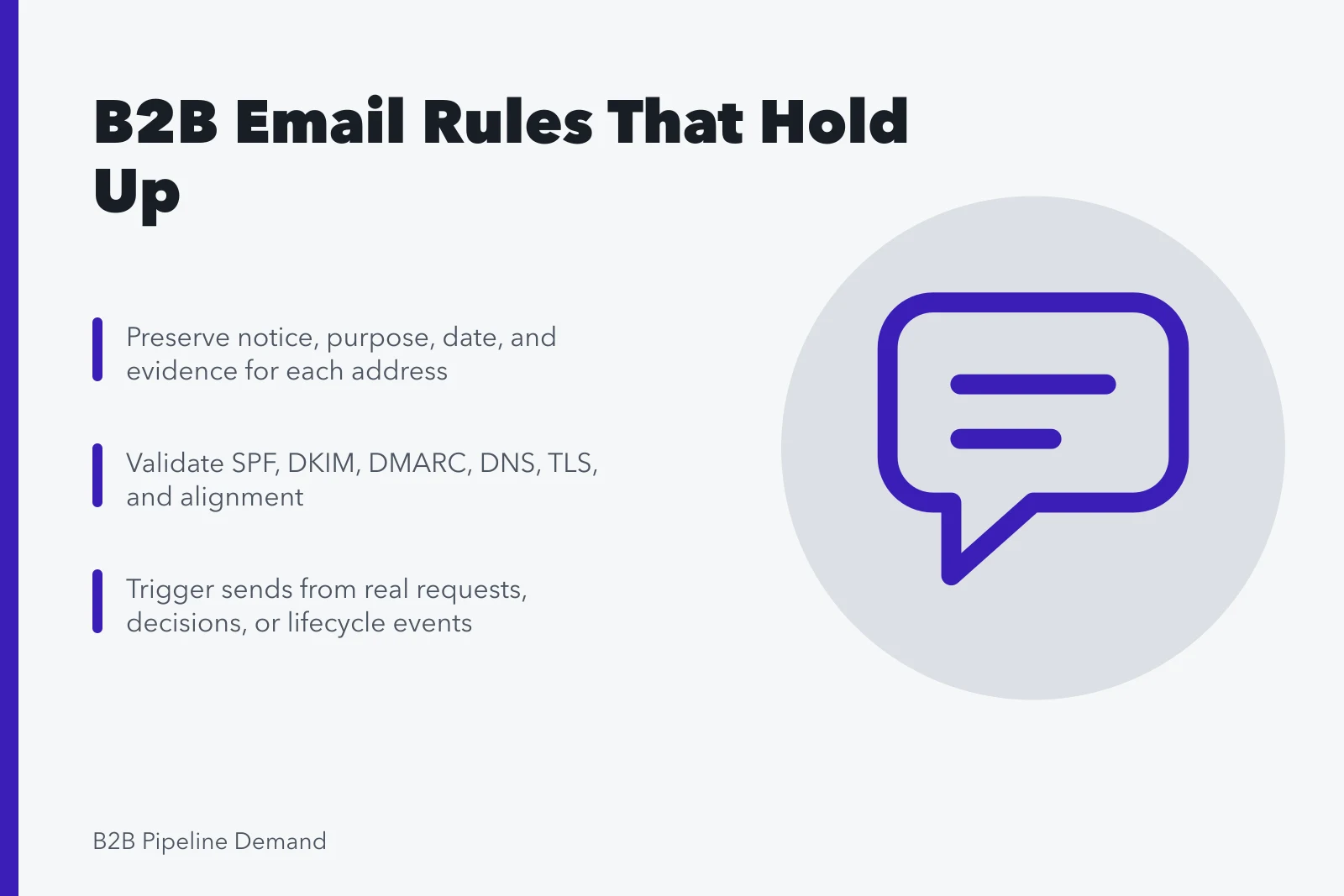
- Acquire addresses transparently and preserve the source, notice, purpose, date, status, and evidence for each approved route.
- Authenticate legitimate senders, keep complaint rates low, make unsubscribe easy, and coordinate total pressure across teams.
- Use clear language, meaningful links, useful alternatives, logical structure, mobile testing, replies, and a working destination.
B2B email marketing best practices protect the recipient's attention and the organization's right to keep sending. They are operating controls, not tricks for forcing a temporary metric increase. Adapt them to applicable law, message type, recipient expectation, mailbox-provider rules, sector risk, and company capacity.
Acquire addresses transparently
Explain the sender, topic, frequency, data use, and exit at collection. Preserve the notice and evidence supporting the route. Do not assume a public, purchased, partner, or event address is automatically available for every later purpose.
Use an identity recipients recognize
Keep From names, domains, subjects, postal details, privacy information, and reply handling accurate. Separate operational and promotional purposes where needed, but do not rotate identities to avoid complaints. The U.S. CAN-SPAM guide requires accurate routing and subject information and places responsibility on the promoted company even when a vendor sends. Identity drift is a recurring B2B email marketing mistake.
Authenticate every legitimate sender
Yahoo's sender page requires authentication and low complaint rates for all senders and adds SPF, DKIM, DMARC, alignment, and easy unsubscribe requirements for bulk senders. Verify the current provider rule against the exact traffic.
Sender authentication checks
- Validate SPF records
- Validate DKIM signatures
- Validate DMARC policy
- Check DNS and TLS
- Confirm domain alignment
- Test bounce processing
- Verify message format
Inventory platforms, restrict access, and validate SPF, DKIM, DMARC, DNS, TLS, alignment, bounce processing, and message format. Google requires baseline authentication for senders to Gmail and adds controls for senders above its bulk threshold. Increase new traffic gradually with recipients who expect it.
Send one useful message at the right time
Trigger from a real request, decision, or lifecycle event. State the reason for sending early, provide specific evidence, keep one primary action, and define exit conditions. Coordinate total frequency across marketing, sales, events, product, and customer teams. Relevance cannot be repaired by inserting a first name into an unwanted email.
Make access and exit easy
W3C's link technique explains that descriptive anchor text helps people understand a destination before following it. Apply that principle in the email and destination, then test with representative clients, zoom, keyboard use, and assistive technology instead of trusting the editor preview.
Test mobile layout, readable type, logical order, descriptive links, alt text, contrast, plain text, replies, and the destination. Provide a visible unsubscribe and any required one-click mechanism. Honor the request within the applicable period and synchronize suppression across every approved route without requiring login or a survey. The B2B email marketing checklist covers the rest of the release review.
Measure outcomes with limits visible
Match the primary metric to the message's job and use delivery, bounce, complaint, unsubscribe, and accessibility as guardrails. Privacy prefetching can inflate opens, so include click quality, replies, destination behavior, qualified account progress, and business outcomes. Document definitions and investigate route-level changes before scaling.
Best-practice operating record
| Practice | Visible evidence | Failure signal |
|---|---|---|
| Transparent acquisition | Source, notice, purpose, time | Origin is unknown |
| Trusted identity | Sender, authentication, reply | A route is unowned |
| Useful message | Decision, evidence, action, exit | Only cadence drives it |
| Honest measurement | Definitions, limits, guardrails | Open equals attention |
Assign the practice
The NIST Privacy Framework starting guide outlines a voluntary process for identifying and managing privacy risk. Use it to assign data and response owners for these practices; it is not legal clearance.
The CISA business-system logging guidance explains how event records support security review. Preserve access, change, failure, and correction records without claiming that logging validates a metric. A number means little without a defensible B2B email marketing benchmark.
Common questions
What is the most important B2B email best practice?
Send only through a defensible route to a recipient who can recognize the sender, understand the purpose, obtain value, and leave easily.
Should promotional and transactional email use the same route?
Separate them when it improves identity, control, monitoring, or risk handling, while maintaining coordinated domain governance, incident response, and recipient protection.
How often should best practices be reviewed?
Review on a risk-based schedule and after material changes to law, provider rules, vendors, domains, data, volume, automation, message class, complaints, or incidents.