Operations
Part of How B2B content marketing works for a business team
Straight answers to the B2B content marketing questions
Common B2B content marketing questions in 2027 cover topic choice, publishing cadence, gated assets, artificial intelligence, formats, distribution, and measurement.
What to take away
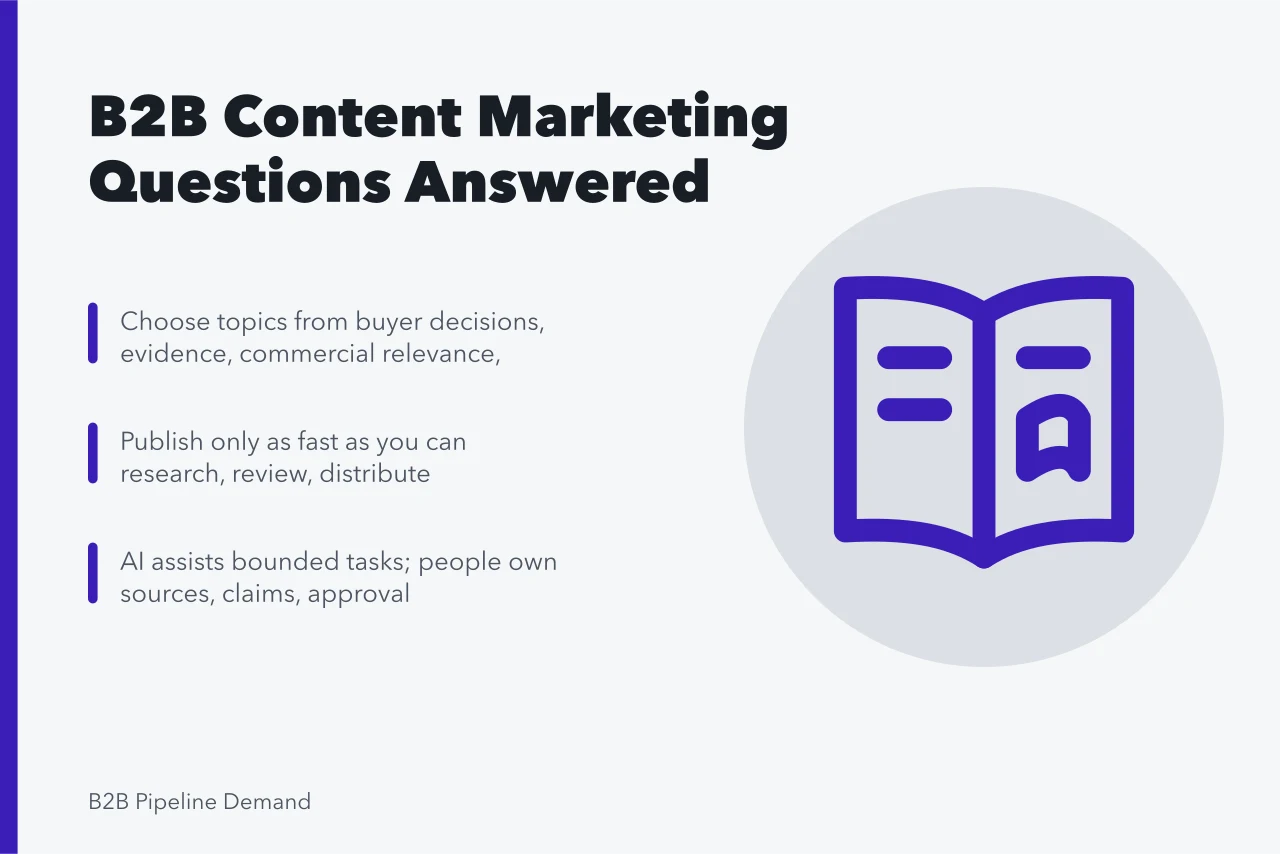
- Choose topics from buyer decisions, evidence access, commercial relevance, and distinct intent, not traffic alone.
- Publishing frequency should follow the capacity to research, review, distribute, learn, and maintain.
- Artificial intelligence can assist bounded tasks, but accountable people still own sources, claims, originality, privacy, and approval.
Common B2B content marketing questions are easier to answer after the team defines the buyer decision and commercial job. The answers below need adapting to the audience, product, region, law, evidence, and capacity. A universal publishing frequency or format is rarely defensible.
What counts as B2B content marketing?
Useful material that helps a defined business audience understand, evaluate, implement, or improve something can qualify. Articles, research, tools, events, video, documentation, customer stories, email, and sales material may all contribute. The label matters less than the reader's decision, the evidence provided, and the accountable commercial purpose.
How should topics be chosen?
Google's SEO Starter Guide defines SEO as helping search engines understand content and helping users decide whether to visit. Use search language to improve discovery and clarity after the audience and decision are real, not to justify unrelated publishing.
Start with buyer research, sales and service questions, product evidence, market change, and search language. Topic choice follows B2B marketing strategy, not the keyword list.
Group topics by distinct decisions and substantially overlapping intent. Reject subjects outside the editorial mission, even with traffic. Google advises creating for an existing or intended audience rather than producing many unrelated topics mainly for search visits.
How often should a company publish?
Publish only as often as the team can produce original value, review claims, distribute the work, and keep existing assets correct. A stable monthly research asset can outperform daily summaries that add nothing. Plan capacity from research and quality requirements, not a competitor's visible cadence.
Should content be gated?
Gate when the exchange is clear, proportionate, permissioned, and useful, like a tool needing saved inputs or a requested event. Keep essential evaluation evidence accessible where possible.
A form completion does not prove purchase intent, so explain data use and offer another path for buyers who prefer anonymous research. A gated download usually feeds B2B email marketing, so say so before the form.
Can artificial intelligence write the content?
Google says automation is not automatically spam, but automation used mainly to manipulate rankings violates its policies. Editorial approval must still validate the reader value, expertise, sources, factual claims, and creation disclosures required by the actual context.
It can assist defined tasks, but accountable people must control sources, expertise, claims, originality, privacy, and final approval. Disclose material automation when readers would reasonably expect it. Google emphasizes Who, How, and Why. Never invent experience or evidence.
How should results be measured?
Match measures to the asset's job: intended reach, useful consumption, repeat use, search visibility, subscription, qualified account action, opportunity progress, retention, or revenue evidence. Keep denominators and windows visible. Search Console measures Google Search appearances and clicks, while other systems answer different questions.
Quick content answer guide
| Question | Decision rule | Warning |
|---|---|---|
| Topic | Distinct buyer decision | Traffic without fit |
| Cadence | Quality and maintenance capacity | Competitor imitation |
| Gate | Proportionate useful exchange | Form fill called intent |
| Automation | Bounded task with review | Invented evidence |
Resolve the question with a decision record
The GAO evaluation design guide connects evaluation questions with evidence needs and design choices. Apply that discipline to these questions; the guidance does not make a local marketing result causal or transferable. Measurement definitions belong with B2B marketing analytics, not with a content calendar.
The W3C Privacy Principles statement gives web-system designers shared privacy concepts and warns against shifting privacy work to individuals. Apply it to reader data, then review the governing law and configuration.
Common questions
Does B2B content marketing require a blog?
No. Any of those formats can help when it serves a defined decision and retains evidence.
Should every asset generate leads?
No. Give each asset a job: build memory, answer evaluation questions, reduce implementation risk, support sales, or help customers rather than collect a form.
Can one article target several keywords?
Yes, when the terms express the same reader intent. Separate pages only when the audience, decision, evidence, or useful action is meaningfully different.