Reviews
Part of The practical guide to B2B lead generation
How to improve B2B lead generation for business teams: the parts worth your time
How to improve B2B lead generation in 2027 by repairing definitions, audience fit, offers, forms, data origin, qualification, routing, and downstream evidence.
What to take away
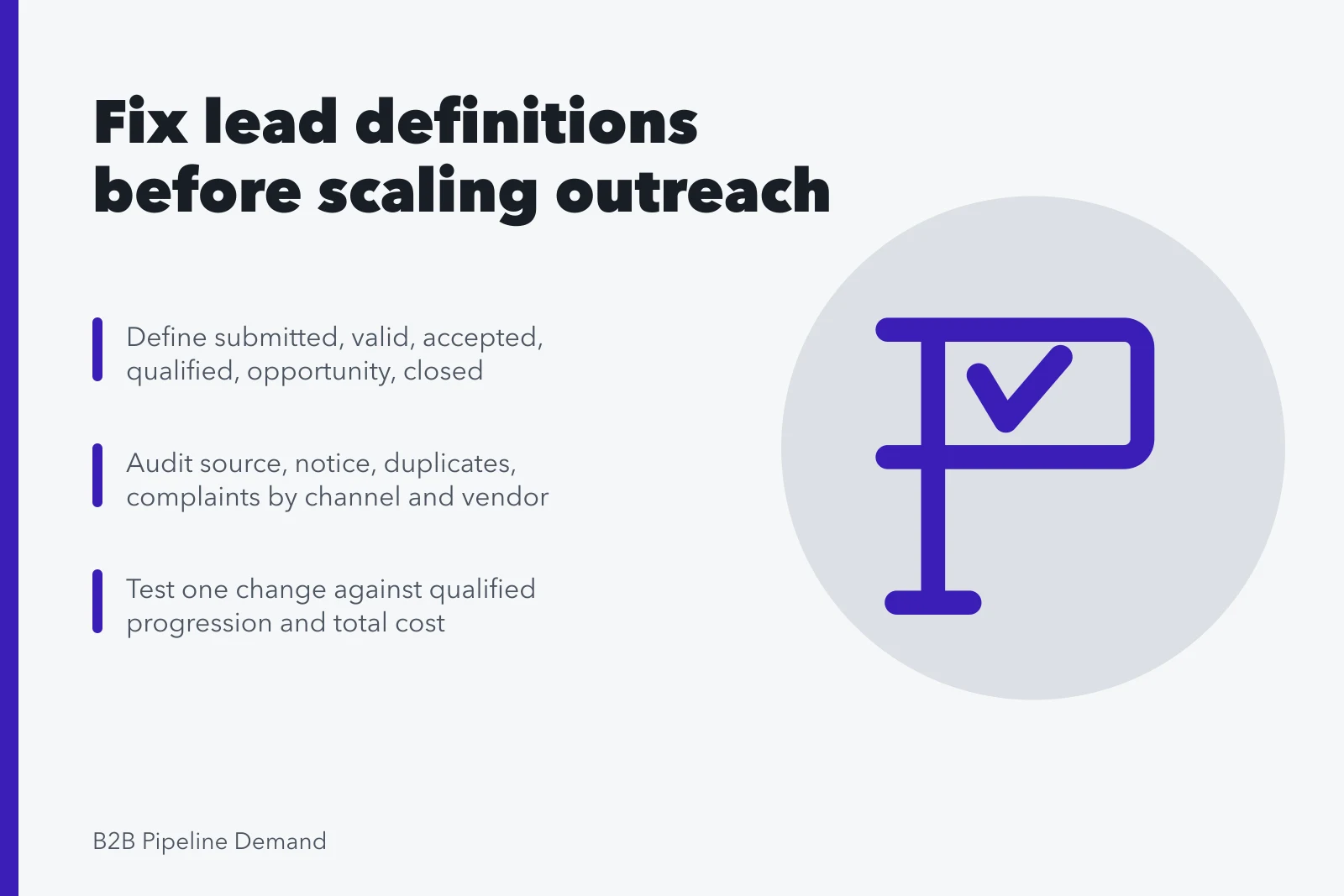
- Repair the lead and stage definitions before changing offers, fields, targeting, scoring, routing, automation, or bid strategy.
- Audit source, notice, permitted use, delivery, duplicates, invalid records, complaints, and downstream outcomes by channel and vendor.
- Test one change against qualified progression and total cost, with privacy, service, sales-capacity, and data-quality guardrails.
Learning how to improve B2B lead generation begins with a source-to-outcome audit. Split results by audience, offer, channel, campaign, region, account status, device, form, qualification path, and owner. Review valid and rejected records, contact outcomes, opportunities, costs, complaints, duplicates, and sales time.
Repair the definition first
Write criteria for submitted, valid, marketing accepted, sales accepted, qualified conversation, opportunity, and closed outcome. Add exclusions, time windows, examples, and reason codes. Recalculate recent cohorts. If one team counts downloads while another counts conversations, a larger dashboard will only scale the disagreement.
Check audience and problem fit
Interview customers, lost buyers, non-buyers, sellers, and service teams. Compare strong and weak cohorts by operating need, trigger, constraints, region, technology, and implementation capacity. Tighten exclusions when the company cannot help. Replace broad persona language with a buying situation and a consequential question.
Make the offer worth the exchange
Google Ads documents eligibility, privacy-policy, campaign, conversion-goal, geographic, field, delivery, and download conditions for its lead form assets. Treat those conditions as platform requirements, not proof that a form is useful, lawful, accessible, secure, or commercially qualified.
Show who the resource serves, which decision it improves, what evidence it contains, and what it cannot answer. The resource is B2B content marketing, judged by whether it helps a decision.
Remove gates that do not support fulfillment or a requested next step, and for retained forms request only needed fields and explain the follow-up. LinkedIn recommends three or four fields for its Lead Gen Forms, but test the actual audience and workflow.
Audit data origin and delivery
The FTC's 2024 Response Tree settlement alleges deceptive consent practices and assistance with unlawful telemarketing, and describes an order barring the company from telemarketing calls. Use this lead-source enforcement record to challenge seller assurances, while applying the final order and current law only to their proper facts and jurisdiction.
Trace every record to the collection point, notice, choices, timestamp, partner, and intended channel. Verify required fields, duplicate handling, region, suppression, and deletion. A spreadsheet from a vendor is not provenance.
Fix qualification and routing
Keep fit separate from intent. Inspect scoring features, negative criteria, age, override, bias. Send original question, offer, source, stated preference to responsible person. Add absence coverage and alerts.
Accepted records enter the B2B sales funnels carrying that same evidence, or they should not enter at all. Measure time to useful human response, accepted rate, successful contact, and reasons sales rejects records.
Run one controlled change
Choose the largest supported failure, then test one offer, field set, message, source, response time, or routing rule. State the outcome, guardrails, window, and stop condition before launch. Judge the change through qualified conversations and opportunity evidence, not form completion alone. Preserve what else changed during the test.
Improvement priority record
| Observed failure | First repair | Evidence of progress |
|---|---|---|
| High volume, low acceptance | Definition and targeting | Accepted-fit rate improves |
| Form abandonment | Value, fields, usability | Useful completion improves |
| Unknown partner records | Origin and permitted-use audit | Every record is traceable |
| Slow or irrelevant follow-up | Routing and response promise | Qualified response time improves |
Run a controlled handoff
The GOV.UK technology selection guidance recommends adaptable choices, data control, security review, and ownership-cost analysis. Use those public-service questions when assessing lead tooling; they are not product endorsements. A tool choice does not settle the common B2B lead generation questions about definitions, origin, and follow-up.
The CISA software acquisition fact sheet covers development practice, supply-chain exposure, deployment, and vulnerability management. Add those government-acquisition questions to a lead tooling review without treating them as local approval.
Common questions
What should a B2B lead program improve first?
Fix the largest verified legal, privacy, source, identity, qualification, routing, or customer-harm failure before increasing volume or automation.
How long should a lead-generation test run?
Set a window that covers acquisition, qualification, sales acceptance, buying-cycle delay, sample needs, and reporting lag before looking at results.
Should a low form-completion rate always be increased?
No. A lower rate may be appropriate if it prevents irrelevant or unsafe submissions. Judge completion with downstream quality, cost, user value, and risk.